The Jimny Buyer’s Question: Buying a Modified Jimny or Someone Else’s Project?
21st Sept 2026 1 6 minute read

Buying a modified Jimny requires careful thought. If you’re buying a modified Jimny in Ireland or the UK, the goal is not simply to find one with a lift, steel bumpers, and all-terrain tyres, but to make sure you are getting a well-sorted vehicle with quality upgrades that suit Irish roads rather than someone else’s half-finished project, complete with poor geometry, mystery wiring, and a collection of expensive problems.
That distinction matters especially in Ireland and the wider UK market, including Northern Ireland. A Jimny that behaves perfectly during a dry test drive still has to deal with Dublin traffic, wet roundabouts, narrow back roads, motorway runs, tax requirements, and the NCT pass.
The right suspension upgrades and modifications can improve a Jimny’s capability, performance, and style, enhancing both its character and individuality. The wrong ones can spoil how it drives, accelerate wear, reduce resale appeal, and leave the next owner paying to put things right or dealing with compliance issues.
This guide is aimed at prospective Jimny buyers who want a compact 4x4 that fits their real use, and it focuses on the checks that matter most: suspension and lift kits, wheels and tyres, electrical accessories, roof racks and exterior parts, signs of hard off-road use, imported examples, pricing, finance, and the red flags that separate worthwhile modifications from problematic ones.
So, before you buy, ask the question that matters most: are you buying a well-sorted Jimny—or inheriting someone else’s experiment?
Why Modified Jimnys Need a Different Buying Approach
The Jimny is one of the most customisable small 4x4s on the road. That’s part of its appeal. Owners fit suspension, wheels, tyres, roof racks, grilles, LED light bars, snorkels, winches, and interior upgrades to create something genuinely personal.
But modifications don’t automatically add value. Their value depends on the quality of the parts, the standard of installation, and whether the finished vehicle works as one coherent package. It’s essential to ensure every modification complies with local vehicle inspection standards and safety regulations to pass the roadworthiness test.
In our experience, the best modified Jimnys feel deliberate. The suspension, tyres, and accessories suit the owner’s real use, and there’s paperwork to explain what was fitted and why. This proof and documentation are essential for insurance and resale.
The worrying examples tend to have layers of unrelated Jimny aftermarket parts, no invoices, and vague answers from the seller. A bold stance can distract from basic issues underneath.
Start With the Car, Not the Accessories
It’s easy to price the winch, roof rack, and wheels in your head before checking the vehicle itself. Reverse that order.
A strong base vehicle matters more than a long accessories list. Check the Jimny’s age, mileage, service history, ownership history, and general condition before assigning any value to its modifications.
Look closely at the chassis and underbody. Irish roads, winter grime, and moisture are hard on any 4x4, while a vehicle used on beaches, farms, or muddy trails may need more scrutiny than a tidy urban example.
You also want consistency. A clean cabin paired with a heavily marked underside may suggest harder use than the presentation implies.
Fresh underseal isn’t automatically suspicious, but you should understand what’s beneath it and when it was applied.
Used Jimny Modifications: What Should You Check?
Every modified Jimny deserves a proper inspection, but several areas warrant particular attention.
Suspension Upgrades and the Jimny Lift Kit
A Jimny lift kit can improve ground clearance and make room for larger tyres, enhancing off-road capability and the view of the road ahead. Done properly, it can be a useful upgrade for off-road driving and daily use.
Done badly, it can introduce vague steering, vibration, uneven tyre wear, or poor handling. The taller the vehicle becomes, the more important it is that geometry and supporting components, including caster correction and driveline angles, have been considered.
During a Jimny inspection, check:
Who made the lift kit and what height is it?
Is there an invoice or fitting record?
Are the springs and dampers a matched set?
Have brake hoses, caster correction, and driveline angles been addressed where necessary?
Does the vehicle sit level?
Are there signs of rubbing, loose hardware, or stressed bushes?
Does it track straight and settle cleanly after a bump?
On a test drive, pay attention at urban speeds and on a faster road. A Jimny will never drive like a low hatchback, but it shouldn’t wander unpredictably, shake through the steering, or feel nervous under braking.
Wheels and Tyres
Oversized tyres transform the look of a Jimny, but bigger isn’t always better. Additional weight can affect acceleration, braking, gearing, fuel use, and tax.
An unsuitable wheel offset may also place extra load on components or cause contact with bodywork.
Check that all four tyres match in brand, model, size, and wear level. Inspect the spare too.
On a four-wheel-drive vehicle, a mismatched set can be a clue that the build was managed to a budget.
For Irish use, think honestly about where the Jimny will spend its time. An aggressive mud tyre may be excellent in a field but noisy and less reassuring on a wet N81 commute.
Electrical Accessories and Lighting
Auxiliary lights, heated seats, upgraded audio, USB points, and LED light bars can make a Jimny more enjoyable and improve visibility and safety, especially during night driving or foggy conditions.
The risk is hidden behind the dashboard. We often see electrical additions treated as small jobs when they need careful installation.
Loose wiring, poor earths, overloaded circuits, and unprotected connections can create intermittent faults that are difficult to trace.
Ask who completed the work. Check that switches operate cleanly, warning lights go out correctly, and accessories don’t interfere with the standard systems.
Roof Racks, Ladders, and Exterior Parts
Roof accessories suit the Jimny, but they also add weight high up, affecting handling and power delivery.
Check mounting points, seals, and signs of water entry. Make sure the setup is appropriate for the vehicle and for the load you intend to carry.
Steel bumpers, underbody protection like skid plates, and recovery points deserve the same attention. A properly fitted winch can be essential for self-recovery in off-road situations. Snorkels can improve engine air intake in dusty environments and other challenging conditions, so judge them on function as well as appearance. Heavy, poorly mounted parts may change how the vehicle drives without delivering a real benefit.
Suzuki designed the Jimny around a ladder frame, rigid axles, and a low-range transfer gear. That’s why it’s such a capable compact off-roader.
Modifications should work with that engineering—not try to disguise poor maintenance.
Has It Been Used Off-Road—or Abused Off-Road?
Off-road use isn’t automatically a reason to walk away. A Jimny is built to leave the tarmac, and a well-maintained vehicle can handle years of responsible use.
The question is how it was used and cared for afterwards.
Inspect the chassis, axles, suspension mounts, sills, bumpers, and exhaust for impact damage. Look for packed mud in awkward areas, damaged guards, and fluids seeping around the drivetrain.
Test four-wheel drive and low range correctly and safely. Listen for unusual knocks on full lock and vibration under load.
If the seller discourages a proper inspection or can’t explain how the four-wheel-drive system operates, take that seriously.

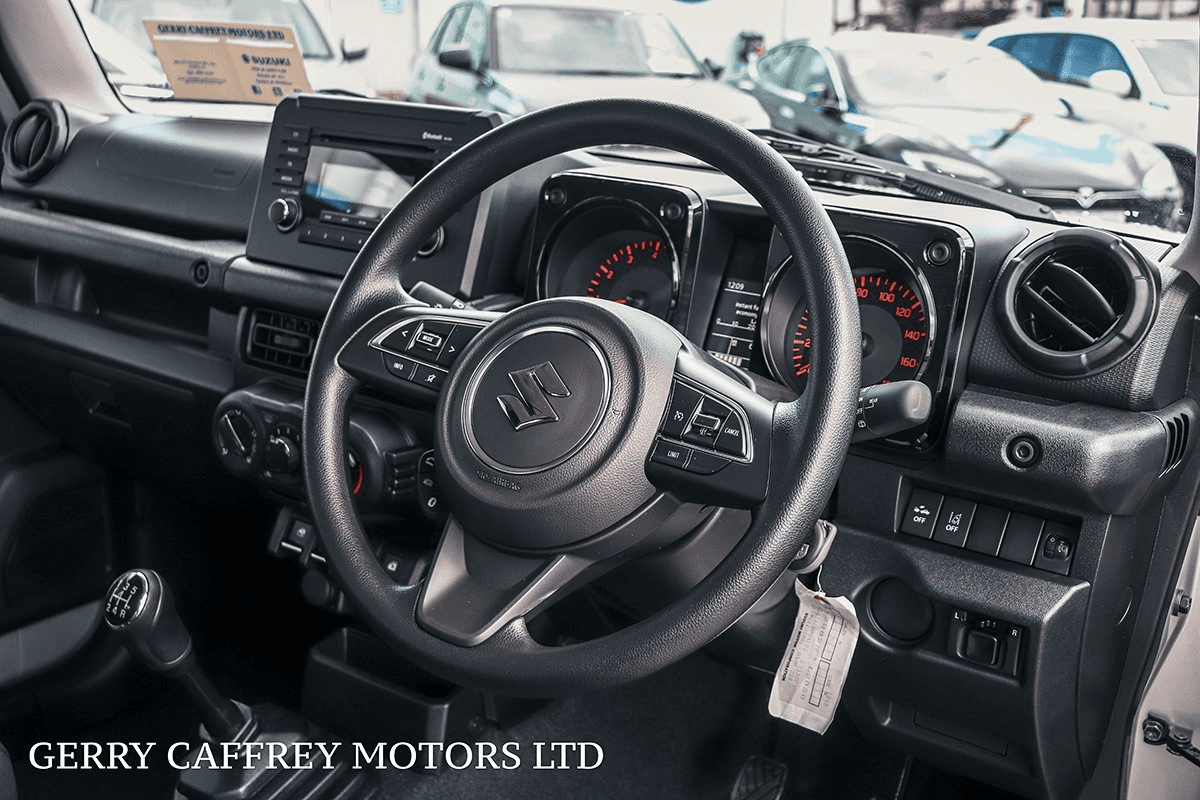
What a Proper Jimny Inspection Should Cover
A quick look around the forecourt isn’t enough. A meaningful Jimny inspection combines documents, condition checks, and a road test.
At minimum, review:
Service records and invoices
Chassis and underbody condition
Evidence of accident repairs
Engine and transmission behaviour
Cooling system and fluid condition
Steering, wheel bearings, and suspension
Brakes and tyre wear
Four-wheel-drive and low-range operation
Warning lights and electrical accessories
Modification brands, fitting quality, and supporting paperwork
The NCT is an important roadworthiness and emissions inspection, but a valid certificate shouldn’t replace your own pre-purchase assessment.
An NCT certificate doesn’t tell you whether a particular suspension setup suits your needs or whether a recent modification was completed to a high standard.
If you’re unsure, get the vehicle assessed by someone who knows Jimnys. Model-specific expertise helps separate normal Jimny characteristics from genuine warning signs.
Buying an Imported Jimny in Northern Ireland: Provenance Matters
An imported Jimny can be an excellent way to access cleaner examples, distinctive specifications, and models that are difficult to find locally.
Japan also offers an enormous choice—but choice alone isn’t quality control.
You need to know where the vehicle came from, how it was graded, and what checks were completed before purchase. Auction information should be interpreted, not simply forwarded.
Any modifications fitted in Japan still need to be evaluated for condition and suitability for Irish and UK use.
There’s paperwork to handle too. On many imports, customs duty and VAT at 23% apply, while Northern Ireland imports follow different VAT rules. VRT depends heavily on the vehicle’s CO₂ emissions. The vehicle must be registered within 30 days of entry. Supporting documents have to be managed correctly, and Revenue requirements can change.
At The Jimny Co, we handle the full journey for our customers: finding the right Jimny in Japan through trusted dealers, sourcing carefully selected vehicles, inspecting them, managing the sale, shipping them, completing VRT and registration, preparing them for Irish roads, and supplying them with warranty cover. The import process typically takes 4-8 weeks.
That joined-up process is important. You’re not left trying to work out whether an unfamiliar auction description, accessory, or repair should concern you after the vehicle has already landed in Dublin.
When Modifications Add Real Value
Good modifications solve a real problem while improving both style and function.
They might improve traction for off-road use, add practical storage, protect the cabin from muddy gear, or simply create a look the owner loves.
A sensible build usually has three qualities:
Purpose: Every major part supports how the vehicle will be used.
Quality: Recognised components are fitted carefully, with receipts and specifications available.
Balance: The build preserves safe, predictable road manners and doesn’t overload the Jimny with unnecessary weight.
If you mainly drive around South Dublin with occasional weekends in Wicklow, you probably don’t need the same setup as a Jimny used daily on forestry tracks.
We recommend choosing upgrades that match your real use and stay legal and safe on Irish roads.
The best specification is the one that fits your life, not the one with the longest parts list.
The Jimny Co can help you choose the right colour, trim, and accessories for your needs. That means creating a Jimny around how you’ll actually use it, rather than paying to undo somebody else’s decisions.
Red Flags That Suggest You’re Buying a Project
Walk carefully when several of these appear together:
The seller can’t name the suspension or lift-kit brand
There are no invoices for major work
Different tyre sizes or brands are fitted
Warning lights are dismissed as “just a sensor”
Wiring has visible joins, loose relays, or unsuitable connectors
The Jimny pulls, vibrates, or clunks on the road
Fresh paint or underseal covers isolated areas without explanation
Accessories are mounted poorly or interfere with normal operation
The seller won’t allow an independent inspection
The asking price assumes every modification is worth its original retail cost
One issue may have a simple explanation. A pattern of shortcuts usually tells a bigger story.
Is a Standard Jimny the Safer Buy?
For many buyers, yes. A clean, standard Jimny gives you a known starting point and, for some, can be a favourite base when they want control over every upgrade and add accessories gradually.
That doesn’t mean every unmodified example is automatically good, nor every modified Jimny is risky. Condition, history, and workmanship matter more than originality alone.
The advantage of starting close to stock is control. You can choose a reputable Jimny lift kit, select tyres for Irish weather, and build around your own driving rather than paying to remove parts that never suited you, with suspension or accessory kits chosen later once you understand your own needs.
Price the Jimny You’re Actually Buying
Don’t value a modified vehicle by adding up the seller’s receipts. Accessories rarely return their full purchase and fitting cost, especially if they’re worn, highly personal, or poorly integrated.
Instead, compare the vehicle with a sound standard equivalent.
Then add value for quality parts you genuinely want and subtract the cost of anything that needs to be corrected, replaced, or removed.
Remember the wider ownership picture too. Budget for insurance, maintenance, tyres, tax, and any changes needed after purchase.
Tell your insurer about modifications, check the registration case if classification affects cover or running costs, and confirm cover rather than assuming every aftermarket item is automatically accepted.
If spreading the cost makes more sense, The Jimny Co offers finance options, subject to approval, and packages can include import costs for modified Jimnys. Personal Contract Purchase can offer lower monthly payments. Hire Purchase allows fixed monthly payments until ownership. Applications are straightforward, and online calculators are available. We also take trade-ins, which can make moving from your current car into the right Jimny more straightforward.
Buy the Right Jimny, Then Make It Yours
A modified Jimny can be full of character, properly capable, and great fun to own when it’s sorted properly—the kind of vehicle people love to live with.
The goal isn’t to avoid aftermarket parts. It’s to avoid unknown workmanship and mismatched decisions.
Start with provenance. Inspect the base vehicle. Understand every important modification and judge the complete package on Irish roads, not just in photographs.
If the seller can explain the build, produce the records, and welcome a thorough inspection, you may have found a very good Jimny.
If the answers are vague, the wiring is untidy, and the road manners don’t feel right, you’re probably looking at a project with someone else’s name still on it.
Thinking about a Jimny import or a carefully specified build? We handle it all—from finding and inspecting your Jimny in Japan, where imported vehicles are carefully selected before purchase, to shipping, VRT, registration, warranty, and finance in Dublin, and there’s plenty to manage along the way.
Our Passion for Jimnys is backed by 35+ years of Suzuki Heritage.
The Jimny Co is a sub-brand of Gerry Caffrey Motors — Ireland’s longest-standing Suzuki dealership.
© The Jimny Co 2025
01 490 1134
106 - 112 Terenure Road North,
Dublin 6W, Ireland, D6WWR13