What Does a Healthy Jimny Chassis Actually Look Like?
9th Sept 2026 14 minute read
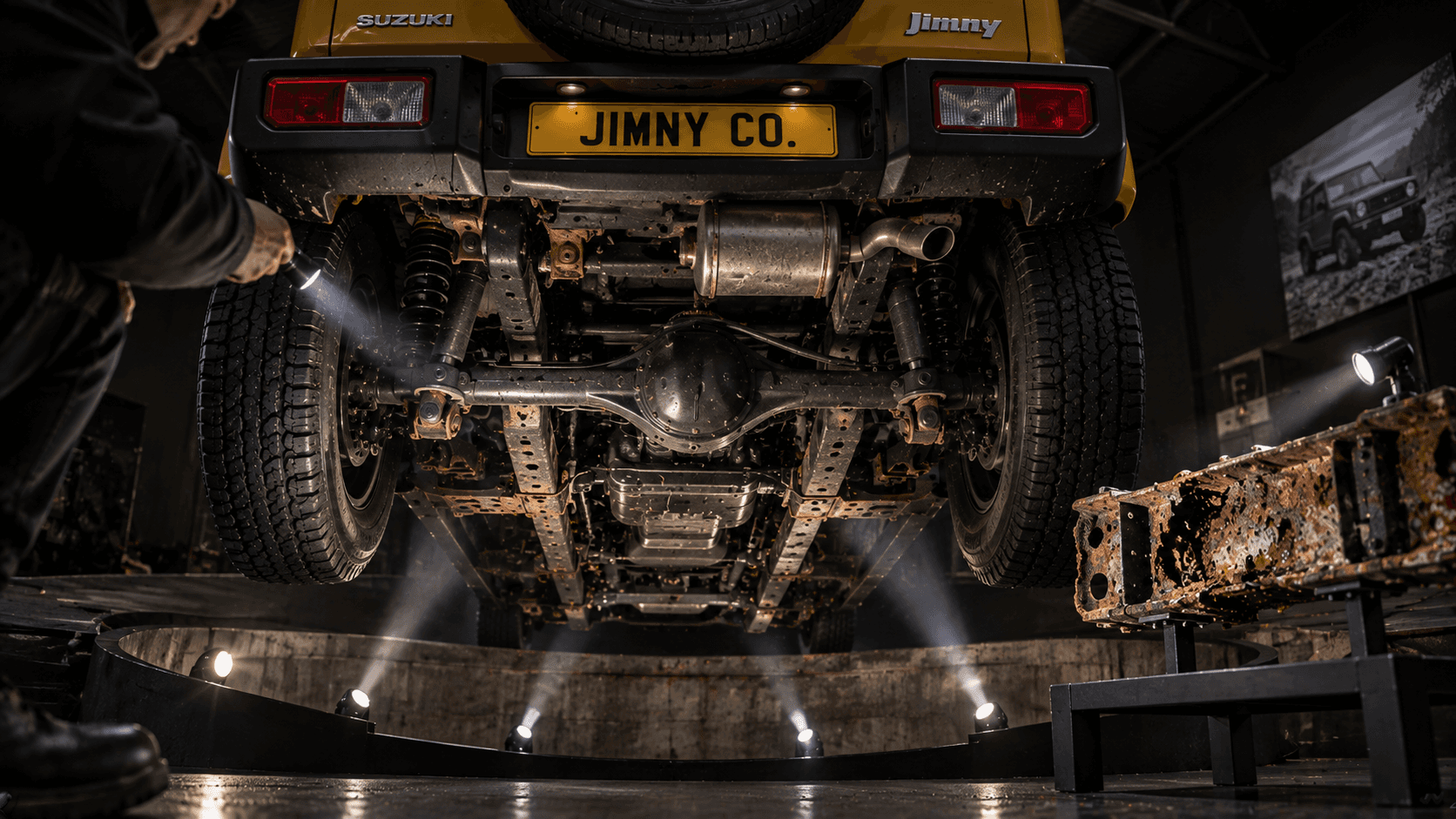
The bodywork can be spotless. The mileage can be low. The cabin can still smell fresh. But when you’re buying a Jimny, the real story is often underneath it.
A healthy Jimny chassis should look straight, solid, and honest. You want clean frame rails, sound mounting points, open drain holes, and consistent factory seams, with no heavy scaling, swelling, cracking, or suspicious patches hidden beneath fresh black coating.
Light surface oxidation isn’t automatically a reason to walk away. Structural Jimny rust is different, and knowing the difference can save you from a costly mistake.
Why the Jimny Ladder Frame Matters
Unlike a typical small crossover, the Suzuki Jimny uses a separate ladder-frame chassis. The body sits on top of that frame, while the suspension, axles, and drivetrain loads are carried through it.
That ladder-frame construction is key to the Jimny’s off-road character. It separates the body from structural loads during off-road impacts, allowing the opposing wheels to react dynamically to uneven surfaces. Suzuki describes the ladder frame, rigid axles, and low-range transfer gear as core elements of the Jimny’s serious 4x4 ability on its official Jimny model page.
The frame features an X-member to enhance torsional rigidity compared to previous generations and supports a robust off-road drivetrain architecture. It is specifically designed to handle large wheel movements over uneven terrain and absorb impacts and twisting forces from rough terrain.
The chassis design allows for effective off-road articulation, with rigid front and rear axles supported by a 3-link rigid axle suspension system with coil springs. Both axles are solid/rigid, contributing to the Jimny's significant approach angle of approximately 41 degrees and ground clearance around 210 mm (8.3 inches).
Modern iterations of the Jimny chassis include crumple zones to enhance occupant safety in collisions, reflecting the evolution of the chassis across generations with significant enhancements in safety and durability. Frame construction methods have advanced to include enhanced crossmembers for structural integrity, and the body-to-frame mounts are engineered for shock absorption and stability during driving.
Since its 2018 model update, the Jimny has a stiffer chassis design, weighing approximately 1,135 kg with rear seats installed. The design philosophy emphasizes off-road capability over the comfort typically found in modern crossovers.
It also means the chassis deserves more attention than the shine on the bonnet. Corrosion in the wrong place can affect structural strength, suspension alignment, roadworthiness, and the value of the vehicle.
In our experience, the best Jimnys aren’t always the ones with the lowest odometer reading. A properly stored and maintained example with a clean underbody can be a much better buy than a lower-mileage vehicle that has spent years exposed to road salt, sea air, or trapped mud.
What Does a Healthy Jimny Chassis Actually Look Like Underneath?
A healthy chassis doesn’t need to look brand new. It does need to look consistent.
On a sound Jimny underbody, the main rails should be straight and retain their original profile. Factory seams and welds should look even from one side to the other, without crude plates, fresh welds, or unexplained distortion.
You’re looking for:
Solid frame rails with no holes, splits, or swollen sections
Clean suspension and shock mounting points
Firm body mounts without crumbling metal around them
Crossmembers that are straight and securely attached
Open drain holes rather than cavities packed with mud
Secure brake and fuel-line brackets
Even underbody protection without thick, localized patches
No obvious accident damage, creasing, or chassis misalignment
A little orange coloring on exposed steel or bolt heads can be normal surface oxidation. Surface rust appears as light orange dusting on metal, which usually sits on top of the metal and may look untidy, but the steel beneath remains solid and retains its original shape.
Structural rot is indicated by heavy, flaky, or bubbly metal. Structural corrosion eats into the steel, causing scaling, pitting, swelling at seams, and eventually perforation. Around a suspension mount, body mount, or chassis crossmember, that’s a serious concern.
The location matters as much as the amount. A small cosmetic patch on a replaceable bracket isn’t the same as corrosion beside a suspension pick-up point.
We often see buyers focus on whether there’s any rust at all. The better question is, where is it, how deep is it, and has the cause been properly addressed?
The Main Jimny Rust Areas to Inspect
A proper used Jimny inspection should cover the entire chassis on a lift. A quick crouch beside the car with a phone torch won’t show enough.
Front Chassis Rails and Crossmember
Inspect both rails from the front bumper backwards. Pay close attention to seams, mounting brackets, and areas where mud or moisture can sit.
Compare the left and right sides. Uneven shapes, rippling, heavy new coating, or non-factory welds may point to previous repair or impact damage.
Suspension Mounts and Shock Absorber Points
These areas carry repeated loads on-road and off-road. Corrosion around brackets, welds, or mounting holes matters more than light rust on a flat, unstressed surface.
Look for cracking, distortion, and metal separating in layers. On a modified Jimny, also check whether a lift kit or other accessory has been fitted correctly and whether it has caused contact, stretched lines, or unusual wear.
Body Mounts
The body is connected to the ladder frame through mounting points and bushes. The surrounding steel should be solid, with no swelling, tearing, or makeshift plating.
Perished rubber bushes can also create movement or knocking. That isn’t necessarily chassis failure, but it should be assessed and priced properly.
Rear Chassis, Crossmember, and Tow Points
The rear of a working or off-road Jimny can collect wet mud and debris. Check around the rear crossmember, bumper mounts, tow points, and any towbar installation.
Fresh paint in one isolated area deserves a closer look. It may be legitimate maintenance, but it may also be hiding corrosion or a repair.
Inside the Frame Rails
The outside of the chassis can look respectable while corrosion develops inside boxed sections. Drain holes should be open, and an inspection camera can reveal far more than an external glance.
Mud packed into a chassis cavity holds moisture against the steel. That’s particularly relevant after regular farm, forestry, beach, or trail use.
Brake Lines, Fuel Lines, and Fixings
The chassis may be the main concern, but the attached components matter too. Check hard lines, clips, brackets, bolts, exhaust hangers, and protective shields for corrosion or poor repairs.
Small neglected fittings can become awkward jobs later. They can also tell you plenty about how the vehicle has been stored and cared for.
Red Flags When Buying a Used Jimny
Some warning signs are obvious. Others are designed not to be.
Be cautious if you find:
Thick, fresh underseal applied without preparation records or before-and-after photographs
Heavy rust flakes falling from the rails or crossmembers
Bubbling along seams or around mounting points
Welded plates with untidy edges or no supporting invoices
Crushed rails or distorted recovery points from off-road impacts
Different finishes on each side of the chassis
Damp mud packed behind guards or inside frame openings
Suspension geometry that looks uneven
A seller who won’t allow an independent lift inspection
Fresh underseal isn’t automatically bad. Applied to clean, correctly prepared metal, it can be valuable protection. Applied over active rust, it can hide the problem while moisture continues working underneath.
Ask what preparation was done, what products were used, and whether there are photographs of the bare chassis before treatment.

Does an NCT Pass Mean the Jimny Chassis Is Healthy?
An NCT pass is important, but it shouldn’t be treated as a complete pre-purchase inspection or a guarantee of future condition.
The test assesses the vehicle against roadworthiness criteria at a particular point in time. A dedicated Jimny underbody inspection goes further by considering early corrosion, previous repairs, off-road damage, and the likely cost of ownership.
If you’re buying a Jimny privately, arrange an inspection before money changes hands. Ideally, use someone familiar with ladder-frame 4x4s and the corrosion points specific to Jimnys.
Why Irish Conditions Make Underbody Care Important
Irish weather is rarely dramatic, but it’s relentlessly damp. Add winter road treatment, coastal air, muddy lanes, and standing water, and the underside of any 4x4 has a hard life.
A Jimny used around Dublin may never have seen a rocky trail, yet repeated wet journeys and limited opportunities to dry can still encourage corrosion. A vehicle working on a farm, towing, launching boats, or exploring trails needs even closer inspection.
South Dublin ownership often mixes short urban trips with weekends in Wicklow or farther afield. That’s exactly why regular washing underneath, clearing drain points, and renewing appropriate corrosion protection matter.
After beach driving or deep mud, rinse the underbody thoroughly with fresh water. Don’t leave compacted dirt sitting around brackets, guards, or chassis openings.
What About a Jimny Imported From Japan?
Japanese imports can offer excellent condition, specification, and choice, but “Japanese import” isn’t a condition report.
Climate and road use vary across Japan. Some vehicles have lived in mild regions; others may have been exposed to snow, road salt, or coastal conditions. Auction sheets and mileage checks are useful, but they don’t replace detailed photographs and a physical underbody assessment.
That’s why our sourcing process starts before the Jimny leaves Japan. We find the right vehicle, arrange inspection, review its condition, and manage shipping to Ireland. We then handle VRT, registration, and preparation, with warranty support once it’s here.
Vehicles imported from outside the state must follow Revenue’s registration and VRT process. Current requirements can change, so buyers should use Revenue’s official VRT guidance rather than relying on old forum posts or estimates.
When we handle the import, the customer doesn’t have to coordinate the Japan-side search, shipping paperwork, revenue process, and Irish registration alone.
A Practical Used Jimny Inspection Checklist
Before committing to a car, work through the following:
Verify identity and history. Match the chassis number to the paperwork and review service, auction, and repair records.
Inspect the vehicle on a lift. View the full length of both rails, crossmembers, and mounts in good light.
Compare both sides. Look for inconsistent finishes, shapes, welds, or replacement sections.
Check inside cavities. Use drain openings and, where appropriate, an inspection camera.
Assess attached components. Examine lines, brackets, bushes, shocks, exhaust fixings, and tow equipment.
Look for off-road contact. Check guards, differentials, radius arms, recovery points, and the underside for dents or scraping.
Road-test it properly. Listen for knocks and note whether it tracks, steers, and brakes consistently.
Review modifications. Confirm accessories are suitable, securely fitted, and declared where required.
Budget for prevention. Even a healthy frame benefits from cleaning, inspection, and appropriate corrosion protection.
Get a written condition report. Photographs and clear findings are more useful than vague assurances.
If you’re still deciding which version or style suits you, browse our Jimny lookbook for previously sourced examples. You can also visit our Jimny article hub for Irish ownership, maintenance, and accessory advice.
Can You Repair a Rusty Jimny Chassis?
Sometimes, yes. Whether it makes financial and safety sense depends on the location, extent, and quality of the proposed repair.
A small, localized repair by a competent specialist is very different from extensive plating across multiple structural areas. You’ll also need to understand what caused the corrosion and whether rust remains inside adjacent sections.
Don’t price a rusty chassis on visible welding alone. Factor in dismantling, fabrication, corrosion treatment, brake or fuel lines, bushes, fasteners, paint, and future resale value.
For most buyers, paying more for a genuinely sound Jimny is less stressful than trying to rescue a cheap one with an uncertain frame.
Keeping a Healthy Jimny Underbody Healthy
Good prevention is fairly simple: inspect, clean, dry, and protect.
Rinse off mud and salt, especially after winter driving, coastal trips, or off-road use. Keep chassis drains clear and have the underbody checked during routine servicing.
Use corrosion protection suited to the area being treated. Cavity wax belongs inside boxed sections, while exposed underbody products must be applied to properly prepared surfaces. Avoid blocking drains or coating rubber, brakes, exhaust components, and other unsuitable areas.
Accessories matter too. Skid plates, side steps, tow bars, and recovery equipment should be fitted so they don’t trap debris or damage the original protection. Recheck mountings after hard off-road use.
Regularly wash the underside to prevent rust, rotate tyres every 10,000 km to maintain even wear, check drain holes monthly to avoid rust issues, inspect the battery health regularly to avoid failures, and perform monthly checks during winter. Inspect the underside and bumpers for damage regularly.
Additional Jimny Ownership Insights
The Jimny is a manageable, slightly slow off roader, but its power and reliability contribute to a unique ownership experience. The manual Jimny variant offers a more engaging drive, while hill descent control adds safety on steep slopes. Despite its compact interior and limited rear seats, the boot space is practical for weekend gear.
When buying a new Jimny or a used model for sale, a test drive is a key step to understand its features, engine responsiveness, and visibility. Dealerships in the UK and Ireland often provide detailed advice on fixing common issues like kingpin bearings wear, which can cause the notorious death wobble at certain speeds (40-50 mph).
Jimny's suspension can develop a 'death wobble' at these speeds, often due to worn kingpin bearings. The 4WD system can fail due to brittle rubber hoses, and the main crankshaft pulley can develop a dangerous wobble.
Fuel economy is reasonable for an off roader, but don’t expect high speeds or a spacious interior like larger SUVs. The tailgate design and interior features, including some models equipped with Apple CarPlay, contribute to a pleasant driving experience.
Owning a Jimny tends to be a bit of a pain when it comes to rust fixing, but with regular maintenance and care, it remains a reliable tool for both city and trail use. Knowing what to expect and having a clear idea of the Jimny’s strengths and limitations helps avoid surprises and leads to a satisfying deal.
Buying Without the Guesswork
The healthiest Jimny chassis is the one you’ve actually seen, inspected, and documented. Clean bodywork and low kilometres are welcome, but they come second to a straight, solid ladder frame with honest protection and no structural corrosion.
At The Jimny Co, we manage the complete journey from Japan to Dublin: sourcing, inspection, shipping, VRT, registration, and warranty. We can also discuss accessories, finance, and trade-ins so the vehicle works for your day-to-day driving as well as your weekends away.
Want to know more about who we are? Read the Jimny Co story.
Thinking about a Jimny import? We handle it all—from Japan to Dublin. Contact The Jimny Co today for a straightforward chat about the right Jimny for you.
Frequently Asked Questions
Is a Little Rust Normal on a Used Suzuki Jimny?
Light surface oxidation on exposed steel or fixings can be normal. Heavy scaling, swelling, holes, or corrosion around the chassis and suspension mounts needs expert assessment.
Where Does a Suzuki Jimny Usually Rust?
Common rust areas include body mounts and chassis rails. Check the front and rear frame rails, crossmembers, suspension mounts, body mounts, tow points, brackets, and the inside of boxed chassis sections. Exact condition depends on age, storage, climate, maintenance, and use.
Can Underseal Hide Jimny Rust?
Yes. Fresh underseal can be good preventative maintenance when the steel has been cleaned and prepared, but thick coating can also conceal active corrosion or repairs. Ask for preparation records and photographs.
Is an NCT Enough Before Buying a Jimny?
No. An NCT is a roadworthiness test at a point in time, not a comprehensive pre-purchase condition report. Arrange a separate inspection on a lift before buying.
Are Japanese-Import Jimnys Rust-Free?
Not automatically. Japan has varied climates, including snowy and coastal regions. Each vehicle should be assessed individually using history, detailed photographs, and a physical underbody inspection.

Our Passion for Jimnys is backed by 35+ years of Suzuki Heritage.
The Jimny Co is a sub-brand of Gerry Caffrey Motors — Ireland’s longest-standing Suzuki dealership.
© The Jimny Co 2025
01 490 1134
106 - 112 Terenure Road North,
Dublin 6W, Ireland, D6WWR13